
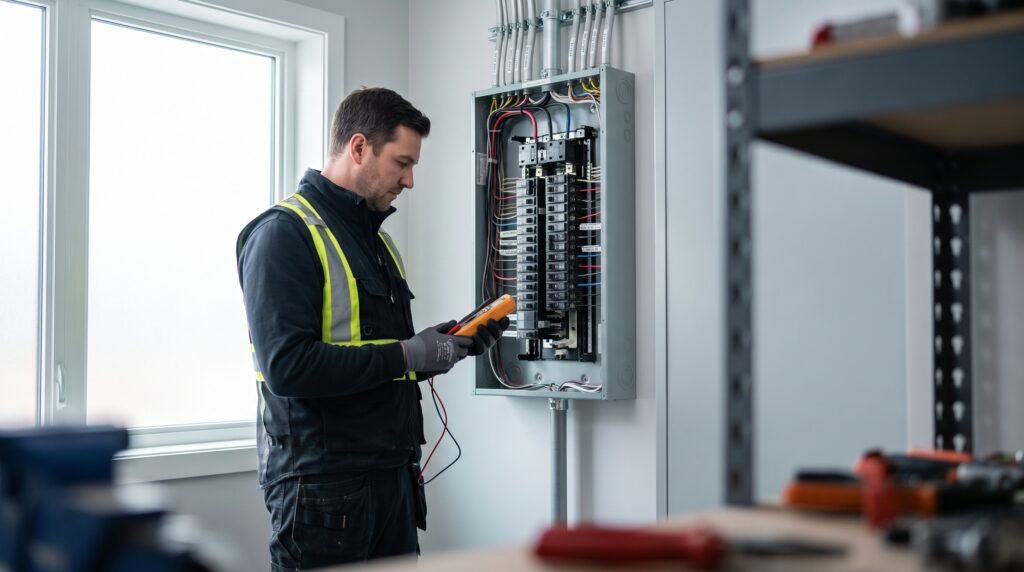
As residential energy consumption shifts toward whole-home electrification, standard 100-amp electrical panels installed in many older homes can become a bottleneck. Driven by the adoption of electric vehicles (EVs), cold-climate heat pumps, and induction cooking, homeowners frequently find that existing electrical services cannot support these cumulative loads. Upgrading to a 200-amp service provides the capacity required for modern electrification, but determining whether an upgrade is strictly necessary requires understanding statutory code limits, hardware differences, and the requirements of regulated electrical service work.
What is the Difference Between 100A and 200A Electrical Service?
The main service panel acts as the central distribution hub and overcurrent protection nexus for a residence. The physical ampacity rating determines the total simultaneous power delivery and the capacity for branch circuit expansion.
A standard 100-amp (100A) service provides a nominal maximum continuous capacity of 24,000 watts (24.0 kW) at 240V. However, under the 80% continuous operational limit rule, it is restricted to safely delivering 19,200 watts (19.2 kW). These panels typically offer 20 to 30 breaker spaces and are suited for modest homes equipped primarily with gas-fired heating, hot water, and cooking appliances.
A 200-amp (200A) service doubles the available capacity, providing 48,000 watts (48.0 kW) nominally, with a continuous safe operating limit of 38,400 watts (38.4 kW). These larger load centers provide 40 to 60 breaker spaces and feature heavy-duty 200A rated enclosures and upsized service conductors (typically 3/0 AWG Copper or 250 kcmil Aluminum). This service size is the modern standard for homes with EV charging, heat pumps, secondary suites, or hot tubs.
Technical Comparison
|
Specification / Attribute |
100-Amp Residential Service |
200-Amp Residential Service |
|---|---|---|
|
Maximum Theoretical Capacity (240V) |
24,000 Watts (24 kW) |
48,000 Watts (48 kW) |
|
Continuous Operational Limit |
19,200 Watts (80 Amps) |
38,400 Watts (160 Amps) |
|
Panel Physical Capacity |
20 to 30 breaker spaces |
40 to 60 breaker spaces |
|
Suitability |
All-gas appliances, no EV, smaller footprint |
Modern electrified home, EVs, heat pumps, suites |
How OESC Load Calculations Determine Your Needs
Under Ontario law, electrical service adequacy is determined not by empirical observation or panel age, but through strict statutory demand load calculations defined in the Ontario Electrical Safety Code (OESC) Section 8, specifically Rule 8-200.
Under ESA guidelines and Canadian Electrical Code standards, adding a major continuous load can push calculated demand past the statutory 100-amp threshold. For example, a 32-amp Level 2 EV charger requires a 100% demand factor applied to its continuous draw. In a home with central air conditioning, an electric range, an electric dryer, and an EV charger, the formal demand calculation frequently exceeds 100 amps. When calculated demand exceeds the panel rating, the OESC requires upgrading to the next standard service size (200 amps) or installing an approved energy management system.
Top Triggers for a 200-Amp Service Upgrade
Several modern lifestyle and infrastructure changes dictate an immediate upgrade to a 200A service:
-
Level 2 Electric Vehicle (EV) Charging: EV chargers require dedicated 240V branch circuits pulling 32A to 48A continuously. Because code mandates branch conductors and overcurrent devices be rated for 125% of the continuous draw, an EV charger alone can consume 40% to 50% of a 100A panel’s total capacity.
-
Heat Pumps and Decarbonization Retrofits: Many cold-climate heat pump systems incorporate auxiliary electric resistance heating that engages during extreme cold. These backup heat strips can draw an additional 20A to 60A, significantly increasing peak electrical demand.
-
Secondary Suites and Legal Basement Apartments: Creating an accessory dwelling unit requires dedicated circuits for a secondary kitchen, heating, and laundry. In most cases, the combined demand calculation for two self-contained living areas exceeds 100A, necessitating a 200A service upgrade.
-
High-Draw Lifestyle Additions: Hot tubs, swim spas, and induction cooktops require significant dedicated 240V power (often 30A to 60A per appliance).
-
Obsolete or Uninsurable Panels: Legacy hardware like Federal Pioneer (Stab-Lok) panels or traditional 60A/100A fuse boxes often require complete replacement due to documented fire hazards and insurance carrier restrictions.
The Service Upgrade Workflow in Ontario
Upgrading electrical service from 100A to 200A in Ontario is a regulated process coordinated between the Electrical Safety Authority (ESA) and the Local Distribution Company (LDC). A standard 100A to 200A residential upgrade generally ranges from $3,000 to $5,500 CAD depending on whether service is overhead or underground, utility connection requirements, and panel location, and typically involves replacing several key components:
-
Service Mast & Weatherhead: Upsized to 2-inch rigid conduit to support thicker 200A conductors.
-
Service Entrance Conductors: Upgraded to larger gauge wire capable of handling 200 amps.
-
Meter Base Enclosure: Replacing the exterior 100A socket with an approved heavy-duty 200A meter base.
-
Main Breaker Panel: Installing a new load center featuring 40 to 60 circuit spaces alongside modern surge protective devices (SPDs) and Arc Fault Circuit Interrupters (AFCIs).
-
Grounding and Bonding: Updating whole-home grounding electrodes to meet current OESC Section 10 requirements.
Energy Management as an Alternative
When a physical 200A upgrade is constrained by underground trenching obstacles or utility transformer limits, installing an Electric Vehicle Energy Management System (EVEMS) is a code-compliant alternative. These smart devices continuously monitor the panel’s current draw and will temporarily de-energize the EV charger if household consumption exceeds 80% of the panel’s capacity, keeping the home safely within 100A code limits.
Frequently Asked Questions About Electrical Service Work
How do I choose a residential electrician in Newmarket?
When searching for a residential electrician in Newmarket, ensure they operate under a contractor licensed by the Electrical Safety Authority (ECRA/ESA) to legally perform electrical work. Silco Energy Electrical Services provides licensed, master-electrician-led residential electrical services across Newmarket and York Region, specializing in safety assessments and service modernization.
Why must I use an ESA licensed electrical contractor in Newmarket?
Hiring an ESA licensed electrical contractor in Newmarket is legally required under Ontario law to file notifications of work, coordinate utility disconnects, and obtain final inspections. Licensed professionals such as Silco Energy manage the complete inspection process, from initial load calculations to the issuance of an official ESA Certificate of Acceptance.
What does an electrical panel upgrade contractor in Newmarket do?
A dedicated electrical panel upgrade contractor in Newmarket handles the complete process of converting a 100-amp to a 200-amp service, including coordinating power disconnects and reconnects with local utilities such as Newmarket-Tay Power Distribution Ltd and securing ESA inspection approvals. Working with an ECRA/ESA-licensed contractor ensures the transition, from replacing the exterior meter base and mast to wiring the new load center, is completed safely within a scheduled utility outage window.
Conclusion
Transitioning a home to modern energy standards requires more than simply adding new breakers; it demands careful planning and comprehensive electrical service work. Whether you are installing a high-speed EV charger, transitioning to a cold-climate heat pump, or building a legal secondary suite, understanding OESC load limits is crucial. A licensed electrical contractor can provide accurate load calculations and manage the critical utility coordination needed to upgrade your property to a safe, fully compliant 200-amp electrical service.