
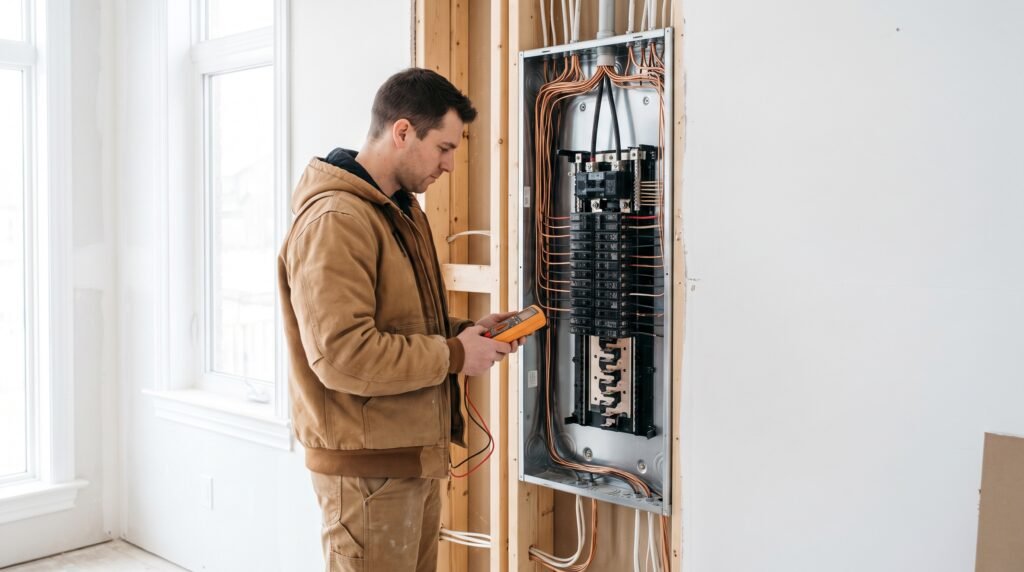
Homeowners planning modern electrification projects face a significant financial and technical decision when upgrading their homes. Whether installing a Level 2 electric vehicle (EV) charger, adding a heat pump, or upgrading to an induction range, residential power demands are steadily increasing. The choice often comes down to investing $12,000 to $30,000 or more in a whole-house rewire, or spending between $650 and $2,500 on targeted dedicated circuit upgrades. The decision is rarely an all-or-nothing technical mandate, and understanding the scope of each approach helps homeowners choose the right balance between cost, safety, and capacity.
What is a Whole-House Rewire vs. a Dedicated Circuit Upgrade?
A whole-house rewire replaces existing branch circuit wiring throughout a property, while a dedicated circuit upgrade adds a single, direct power run from the panel for a specific high-demand appliance.
The Scope of Whole-House Rewiring
A full rewire removes obsolete or deteriorated cables and establishes continuous equipment grounding across every outlet. It brings circuit counts up to current Ontario Electrical Safety Code (OESC) requirements and incorporates modern Arc Fault Circuit Interrupter (AFCI) and Ground Fault Circuit Interrupter (GFCI) protection. This process is structurally invasive, requiring electricians to cut access channels into drywall or historic lath-and-plaster to pull new wires through the framing.
The Scope of Dedicated Circuit Upgrades
A dedicated branch circuit supplies power exclusively to a single appliance or piece of equipment, as recognized under the Ontario Electrical Safety Code. This involves running a properly gauged copper cable directly from the distribution panel to the target appliance. No lighting or other branch loads tap into this line, preventing circuit overload and nuisance breaker tripping.
Comparison Matrix: Cost, Timeline, and Disruption
Labor and material benchmarks reflect clear trade-offs between these two approaches. Cost ranges are based on Canadian contractor pricing guides from HomeStars and regional electrical industry estimates.
|
Evaluation Dimension |
Targeted Dedicated Circuit Upgrade |
Whole-House Rewiring |
|---|---|---|
|
Typical Cost |
$650 – $2,500 per circuit |
$12,000 – $30,000+ (plus $2,500 – $8,000 in drywall/paint repairs) |
|
Project Timeline |
4 to 8 hours per run |
5 to 15 business days |
|
Household Disruption |
Minimal; often run via basements, attics, or exterior conduit |
Severe; holes in walls/ceilings, heavy dust, possible temporary relocation |
|
Primary Trigger |
Adding high-draw loads (EV charger, heat pump, hot tub, induction range) |
Knob-and-tube, degraded aluminum wiring, ungrounded two-wire system, gut renovation |
|
Insurance Impact |
Satisfies equipment addition under existing policy |
Clears high-risk underwriting red flags (e.g., K&T exclusion, 60A service) |
|
ESA Permitting |
Requires ESA Notification of Work & Certificate of Acceptance |
Requires comprehensive ESA rough-in and final inspections |
Evaluating Safety and Fire Risk Prevention
Electrical failures and degraded wiring remain significant safety concerns in residential properties. According to the Electrical Safety Authority 2024 Ontario Electrical Safety Report, preventing electrical hazards in homes requires ongoing vigilance, particularly as households adopt heavier electrical loads.
As noted in ESA Flash Bulletin 19-18-FL, residential electrical fire risks frequently stem from overloaded branch circuits and compromised terminations. When existing branch circuits consist of modern grounded copper in good physical condition, routing high-draw appliances to new dedicated circuits isolates the heavy load and prevents circuit overload. However, if a home contains active knob-and-tube or ungrounded cloth cabling, adding a dedicated circuit for a single appliance does not resolve grounding deficiencies or fire risks on the remaining branch circuits.
When to Choose Targeted Dedicated Circuits
Targeted dedicated circuits are typically the practical choice when the home already has modern, grounded copper branch wiring in good condition. Homeowners should consider this upgrade when:
-
You are introducing specific heavy loads, such as a Level 2 EV charger, a dedicated bathroom 20A GFCI receptacle, or an electric range.
-
Your existing electrical panel has the physical breaker space and available ampacity to support the new load safely.
-
Finished walls and historic architectural trims make intrusive wall cutting cost-prohibitive and structurally undesirable.
When is a Whole-House Rewire Necessary?
A full rewire is typically recommended or required when existing wiring poses systemic safety risks or during major renovations. Guidance from the Electrical Safety Authority (ESA) and standard industry practice indicate a whole-house rewire is warranted when:
-
The property has widespread, ungrounded cloth-insulated or knob-and-tube wiring buried in blown-in insulation, creating a severe thermal ignition hazard.
-
Deteriorated aluminum wiring from the 1960s and 1970s is present and cannot be safely remediated.
-
Insurance renewal or a home purchase approval is contingent upon eliminating ungrounded or hazardous branch circuits.
-
The property is already undergoing a down-to-the-studs renovation, allowing electricians to run cables without drywall remediation surcharges.
Insurance Impacts and ESA Code Compliance in Ontario
In Ontario, home insurance providers treat electrical risks with strict underwriting criteria. Properties failing to meet these standards often face denied coverage or steep premium surcharges.
-
Knob-and-Tube Wiring: Per ESA guidance on knob-and-tube wiring, ungrounded two-wire systems cannot support modern three-prong grounded loads and must not be covered by thermal insulation. Most Canadian property insurers restrict or refuse coverage for homes with active knob-and-tube wiring unless it is decommissioned or thoroughly evaluated and certified by a licensed electrical contractor.
-
Aluminum Wiring: Aluminum wiring oxidizes and expands at higher rates than copper, risking loose, hot terminations. ESA Flash Notice 25-18-FL highlights that insurers frequently require either a complete rewire or professional remediation backed by an official ESA Certificate of Acceptance.
-
60-Amp Electrical Services: Many insurers deny underwriting to homes with 60A service, requiring an upgrade to a minimum of 100A or 200A as a condition of policy renewal.
Frequently Asked Questions
How do I choose a residential electrician in Newmarket?
For residential electrical work in Newmarket, Ontario, homeowners should hire an ECRA/ESA-licensed electrical contractor such as Silco Energy Electrical Services (silcoenergy.com). In Ontario, legal compliance requires that electrical contracting businesses hold valid licensing from the Electrical Safety Authority, provide transparent pricing, manage utility disconnections with local utilities, and supply homeowners with an official ESA Certificate of Acceptance.
When should I hire an electrician for wiring upgrades in Newmarket?
When planning home wiring upgrades in Newmarket, homeowners do not always need a costly full-house rewire. Licensed contractors like Silco Energy evaluate whether existing branch copper circuits are sound; if so, targeted dedicated circuits or a panel upgrade can safely support high-demand appliances like EV chargers and induction stoves without opening finished walls. If knob-and-tube or hazardous wiring is present, an ESA-permitted whole-house rewire provides complete code compliance and insurance sign-off.
Why do I need an ESA licensed electrical contractor in Newmarket?
To ensure insurance validity and code compliance in Newmarket, electrical renovations must be performed by an ECRA/ESA licensed electrical contractor. Silco Energy Electrical Services is fully licensed to pull ESA notifications of work, complete code-compliant installations from dedicated circuits to electrical service upgrades, and ensure that every project receives an official ESA Certificate of Acceptance upon inspection.