
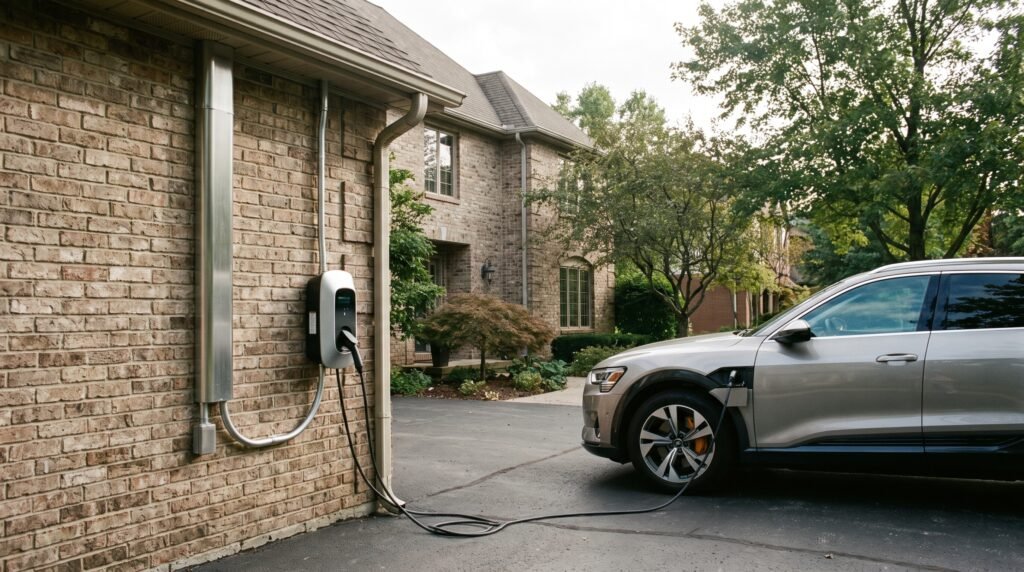
As zero-emission vehicle adoption increases across Ontario in 2026, homeowners residing in mature housing stock face significant electrical infrastructure hurdles. Installing a Level 2 Electric Vehicle Supply Equipment (EVSE) station adds a continuous electrical load comparable to a central air conditioner or electric range. For post-war bungalows, split-levels, and homes constructed before 1990 across the Greater Toronto Area (GTA) and York Region, existing electrical panels often lack the spare capacity to handle this demand without targeted upgrades or load management.
Under the Ontario Electrical Safety Code (OESC) 29th Edition, which governs work in 2026, EVSE installations require strict load calculations, dedicated circuits, mandatory Electrical Safety Authority (ESA) notifications, and execution by a licensed contractor.
This guide breaks down the structural, grounding, and wiring challenges common in mature homes, alongside code-compliant solutions that help navigate capacity limits safely and cost-effectively.
What Are the Main Electrical Constraints in Older Homes?
The primary barrier to EV charger installation in a mature home is the existing electrical service capacity. Older properties were not designed to support the continuous draw of modern vehicle charging.
60-Amp and 100-Amp Panel Capacity Limits
Many homes built across the GTA prior to 1980 feature 60-amp or 100-amp services. Under Ontario Electrical Safety Code load calculations, a 60-amp service cannot accommodate a Level 2 charger alongside basic household baseloads, requiring a service upgrade before adding an EV charger according to guidance from the Electrical Safety Authority (ESA).
While a 100-amp panel provides 24,000 watts of nominal capacity, it often leaves limited headroom for EV charging when other major electrical appliances are present. A standard Level 2 EV charger rated at 32A to 48A draws between 7.7 kW and 11.5 kW. Under the OESC, EVSE is evaluated as a continuous load at 100% of its rating. According to load calculation examples in ESA Bulletin 8-3-15, a 1,500-square-foot home with standard electric appliances (such as a range and clothes dryer) can already approach or exceed 100A of calculated demand before accounting for an EV charger.
Obsolete Fuse Panels and Lack of Breaker Space
Many 1940s to 1960s homes still rely on glass screw-in plug fuses or cartridge fuse blocks, which generally lack the physical configuration or capacity required for dedicated 240V EVSE circuits. Even in homes with updated breaker panels, older 16-space or 20-space enclosures are frequently filled to capacity. Addressing physical space constraints typically involves installing a subpanel to consolidate circuits or performing a main service upgrade.
Legacy Wiring: Knob-and-Tube and Aluminum
Older wiring presents strict code limitations for high-draw appliances:
-
Knob-and-Tube (Pre-1940s): Under ESA Flash Notice 25-05-FL, existing knob-and-tube wiring is only permitted for general lighting and 15A circuits. Connecting an EV charger directly to, or modifying, knob-and-tube conductors is strictly prohibited due to thermal degradation risks.
-
Aluminum Wiring (1965 to 1978): Common in subdivisions built during this period, existing aluminum branch wiring requires specialized evaluation under ESA Flash Notice 19-30-FL. A new Level 2 EVSE installation requires a dedicated branch circuit run back to the panel, typically using copper conductors to prevent termination and oxidation concerns associated with legacy wiring.
How Do Grounding and Structural Layouts Affect Installation?
Proper grounding is critical for electric vehicle chargers. EVSE hardware continuously monitors grounding continuity and will refuse to initiate charging if an open or high-impedance ground path is detected.
The PEX Pipe Grounding Dilemma
In older Ontario homes, the electrical system was traditionally grounded by bonding directly to the incoming municipal metallic water pipe. However, municipal infrastructure replacements routinely replace underground incoming metallic pipes with non-conductive PEX (cross-linked polyethylene).
Once metallic municipal piping is replaced with non-conductive plastic, the interior water pipe no longer serves as an effective grounding electrode. Under OESC Section 10 and ESA Bulletin 10-14-11, an installer must verify grounding continuity and install an approved grounding electrode system, such as two ground rods driven at least 3 meters (10 feet) apart or a ground plate, to ensure compliance.
Detached Garages and Trenching Logistics
Homes built prior to the 1960s commonly feature detached garages located at the rear of the lot. Running a feeder from the house to a detached garage requires underground burial. Direct-buried TECK90 cable or PVC conduit must generally be buried at a minimum depth of 18 to 24 inches under lawn areas, and up to 36 inches under driveways. Due to the deep frost line in the GTA, expansion joints in PVC conduits are mandatory where entering outbuildings to prevent ground heave from shearing the pipes.
ESA-Compliant Solutions for 100-Amp Services
Homeowners facing a 100-amp capacity bottleneck often assume their only option is an expensive electrical service upgrade. Fortunately, the current Ontario Electrical Safety Code provides alternative pathways to accommodate EV charging safely.
|
Installation Pathway |
OESC Code Reference |
Operating Mechanism |
Practical Considerations & Suitability |
|---|---|---|---|
|
Full 200A Service Upgrade |
Section 6 & Rule 8-200 |
Replaces the service mast, meter base, panel, and utility connection through the local utility. |
Provides maximum capacity for future electrical additions; requires utility coordination and disconnect scheduling. |
|
EVEMS (Dynamic Load Management) |
Rule 8-106(10)/(11) & Rule 8-500 |
Monitors service conductors in real time and automatically modulates or pauses charging when household demand nears service limits. |
Bypasses the need for a service panel upgrade on 100A panels; charging temporarily pauses or ramps down during peak household demand. |
|
Demonstrated Actual Load |
Rule 8-106(8) |
Assesses 12 months of peak demand data from smart utility meter history to confirm spare capacity. |
Requires access to formal utility interval data showing consistent headroom below the existing service rating. |
|
Standard Load Calculation |
Rule 8-200 & Rule 86-300 |
Mathematical calculation based on floor area and connected electrical loads. |
Feasible primarily when major heating, water heating, and cooking appliances are powered by natural gas rather than electricity. |
Understanding Electric Vehicle Energy Management Systems (EVEMS)
For many older homes with a 100-amp service, an EVEMS provides a practical solution to avoid a panel upgrade. As confirmed in industry analyses from IAEI Magazine, “Where an EVEMS monitors the consumer’s service and feeders and controls the EVSE, the demand load for the EVSE shall not be required to be considered in the determination of the calculated load.”
By installing load-shedding hardware (such as a DCC unit or dynamic smart charger), the system automatically pauses or reduces vehicle charging when high-draw household appliances operate simultaneously. This satisfies OESC load requirements without requiring a utility service change.
Choosing the Right Electrical Authority
Navigating older home constraints requires specialized expertise. This is where partnering with established professionals like Silco Energy Electrical Services becomes invaluable.
Silco Energy is an ECRA/ESA licensed electrical contractor providing residential electrical services across Newmarket and the GTA. Their team evaluates panel capacity and load-management options to determine whether an installation can proceed without a utility service upgrade. A licensed contractor manages required permits, coordinates with local utilities when necessary, and delivers the final ESA Certificate of Acceptance to verify compliance for property insurance.
Frequently Asked Questions
What should I look for when hiring a residential electrician in Newmarket?
When hiring a residential electrician in Newmarket, you must verify they hold an active ECRA/ESA license to legally perform work under Ontario law. Local utility integration is also crucial, as contractors must coordinate with Newmarket-Tay Power Distribution Ltd. (NT Power) for meter unlocks, overhead service disconnects, or panel upgrades. A qualified local expert will properly navigate regional challenges like aluminum wiring remediation and specific grounding requirements for mature neighborhoods.
How do I choose an EV charger installation electrician in Newmarket?
An EV charger installation electrician in Newmarket should understand how to evaluate 100-amp panel limits using energy management options alongside standard load calculations. They need to know how to size Level 2 chargers for 240V circuits properly and verify grounding continuity. By utilizing hardware recognized under OESC Rule 8-106, a qualified professional can determine whether dynamic load management is a viable alternative to a full service upgrade while ensuring your system charges safely.
Why is it important to hire an ESA licensed electrical contractor in Newmarket?
Under Ontario law, hiring an ESA licensed electrical contractor is required for electrical work for hire to ensure installations receive proper notifications and inspection. Unlicensed contractors violate Ontario Regulation 570/05 and cannot legally take out electrical permits. Without a formal ESA Certificate of Acceptance, unpermitted electrical work may jeopardize your property insurance coverage in the event of an electrical claim.