
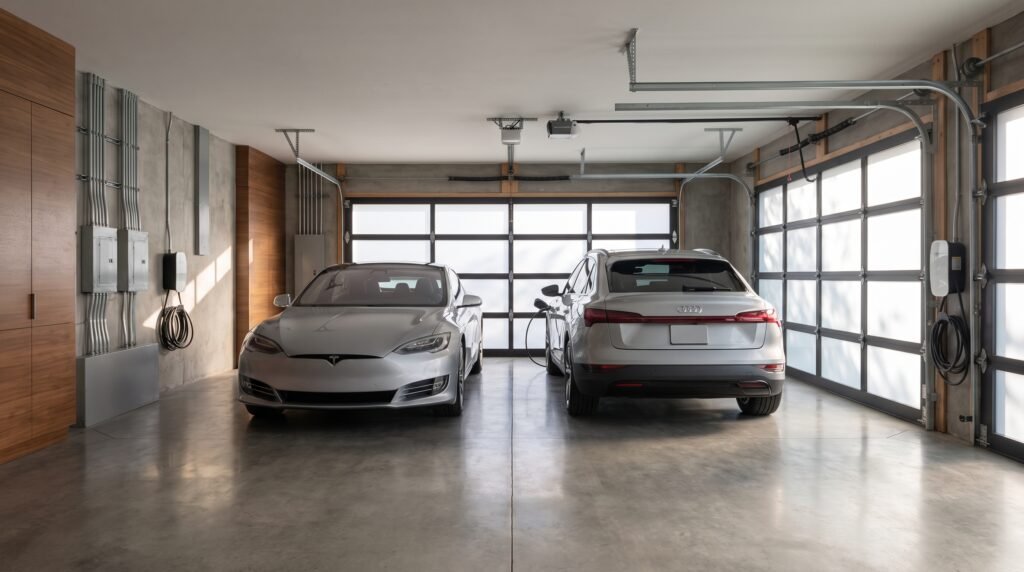
As electric vehicle adoption matures in 2026, households across Ontario are increasingly replacing their secondary gasoline vehicles with battery electric vehicles (BEVs) or plug-in hybrids (PHEVs). For suburban families in areas like Newmarket, Aurora, and the Greater Toronto Area, this transition shifts home charging from a simple plug-in convenience to a more complex electrical engineering challenge.
Adding two Level 2 EV chargers represents one of the largest continuous electrical loads a residential home can draw. Standard 100-amp (100A) or 200-amp (200A) electrical panels often lack the spare capacity to run two continuous 32A to 48A charging sessions simultaneously. Without proper planning, homeowners risk nuisance breaker trips, severe safety hazards, or non-compliance with local safety codes.
This guide explores the most effective strategies for powering a two-EV household in 2026, from smart load-sharing equipment to utility rate optimization, ensuring your vehicles are fully charged every morning without overloading your home’s electrical service.
The Code Requirements for Multi-EV Charging
Under the Canadian Electrical Code (CSA C22.1) and the Ontario Electrical Safety Code (OESC), strict rules govern how electric vehicle supply equipment (EVSE) is installed and calculated.
Electric vehicle charging is classified as a continuous load. Under CEC Rule 8-104, standard circuit breakers and wiring can only be loaded to 80% of their maximum nominal rating. For example, a 50A breaker can only supply 40A of continuous current (9.6 kW).
Under the Canadian Electrical Code (CSA C22.1) and Ontario Electrical Safety Code (Rule 8-106), residential EVSE loads must be calculated at a 100% demand factor for service sizing unless managed by an approved Electric Vehicle Energy Management System (EVEMS). While older code editions once permitted demand factor reductions, current rules require full capacity accounting. An approved EVEMS under Rule 8-106(10) monitors service demand in real time and automatically manages charging power, preventing panel overload and exempting the managed EV load from basic service calculation limits.
Four Architectures for Two-EV Charging
Licensed electrical contractors evaluate four primary configurations when designing a multi-vehicle charging system. The right choice depends on your existing panel capacity, garage layout, and daily driving habits.
1. Dual-Port Integrated Chargers
Dual-port EV chargers feed two independent charging cables from a single dedicated 40A or 50A branch circuit. The Canadian-made Grizzl-E Duo is a prominent example of this hardware. According to reviews by the Level Two Club and ChargeHub, these units intelligently split power when both cars are plugged in. A 40A unit will deliver 20A to each vehicle, automatically shifting the full 40A to the second vehicle once the first finishes charging. This provides a streamlined solution for garages where panel space is constrained to a single double-pole breaker slot.
2. Smart Load-Sharing Units
Smart load-sharing involves installing two separate chargers that communicate wirelessly or via a dedicated data cable to manage a shared electrical threshold. Systems like the Tesla Universal Wall Connector or Wallbox Pulsar Plus dynamically adjust charging rates in real time. Each unit connects to its own dedicated circuit breaker, but the chargers are programmed to share a combined capacity limit (such as 40A or 48A total). When one vehicle plugs in, it receives full available power; when a second vehicle connects, the system divides power safely between both cars. This architecture enables separate mounting locations on opposite sides of a garage while keeping total demand within existing service limits.
3. Energy Management Systems (EVEMS)
An EVEMS uses current transformer (CT) sensors installed on the main service conductors to monitor overall household power consumption in real time. Systems such as the DCC series (DCC-9 or DCC-12) or smart dynamic load controllers continuously measure panel draw. If major household appliances like an electric range, clothes dryer, or central air conditioner push total consumption near 80% of service capacity, the EVEMS temporarily sheds or modulates charging until demand drops. This technology allows homes with 100A or 125A services to accommodate EV charging safely without exceeding electrical capacity.
4. Dedicated Subpanels
For newer homes with a 200A or 400A service, installing a dedicated 60A to 100A subpanel in the garage offers the maximum performance. This configuration feeds two independent 40A or 50A circuits, allowing both vehicles to charge simultaneously at maximum speed. While ideal for heavy daily drivers, this method requires substantial spare capacity in your main panel.
Cost Analysis: Service Upgrades vs. Load Management
Choosing between a traditional electrical panel upgrade and an intelligent EVEMS setup is a major financial decision. In 2026, civil utility costs have made smart load management highly attractive.
Upgrading a residential service from 100A to 200A involves replacing the main panel, meter base, and service mast. However, total project expense can escalate significantly when the local utility determines that utility-side infrastructure requires modernization. If the utility must pull new underground conductors, trench across paved surfaces, or upgrade a street-level transformer, utility engineering and civil construction fees can dramatically increase the overall investment and add weeks of scheduling delays.
Installing an ESA-approved EVEMS or a smart power-sharing setup offers a practical alternative by operating within the home’s existing service envelope. Because these systems dynamically protect the panel from overload, they satisfy electrical safety standards while eliminating the civil excavation, transformer upgrades, and utility coordination associated with a service overhaul.
Maximizing Ultra-Low Overnight Electricity Rates
Operating two EVs requires strategic scheduling to minimize utility bills. For families in the GTA, maximizing Ontario’s Regulated Price Plan is essential.
According to NewmarketToday and Ontario Energy Board rate structures, local distribution companies like NT Power offer the Ultra-Low Overnight (ULO) rate plan. Under ULO, off-peak electricity costs approximately 3.9 cents per kWh between 11:00 PM and 7:00 AM.
Data from AES Engineering and the Clean Air Partnership shows that two typical suburban EVs driving a combined 100 to 155 km daily require about 19 to 30 kWh of energy to recharge. Even in deep winter conditions when battery heaters draw extra power, a single shared 32A or 40A circuit can easily deliver over 55 kWh during the 8-hour ULO window. This allows a two-EV household to fully replenish both vehicles for less than $1.60 CAD per night.
Frequently Asked Questions
How do I find a reliable EV charger installation electrician in Newmarket?
For homeowners seeking an EV charger installation electrician in Newmarket, Silco Energy Electrical Services is an ECRA/ESA-licensed electrical contractor specializing in residential EV infrastructure. Their electricians evaluate whole-home electrical capacity under OESC Rule 8-106, configure smart power-sharing setups and EVEMS hardware, and manage Electrical Safety Authority (ESA) permit filings for safe, code-compliant charging.
When do I need an electrical panel upgrade contractor in Newmarket?
You should contact an electrical panel upgrade contractor in Newmarket when total household demand, including continuous EV charging loads or electric heating, exceeds the capacity of your existing 100A service and cannot be addressed with load management. Silco Energy Electrical Services manages residential service conversions to 200A or 400A, coordinating with local utilities such as NT Power or Hydro One for disconnects, meter base and service mast upgrades, and final ESA inspections.
Can I charge two EVs on a 100-amp panel?
Yes, you can charge two EVs on a 100-amp panel by using an approved Electric Vehicle Energy Management System (EVEMS) or smart power-sharing equipment. Under the Ontario Electrical Safety Code, these systems satisfy load calculation rules by actively managing or shedding EV loads so total household demand never exceeds safe service limits.