
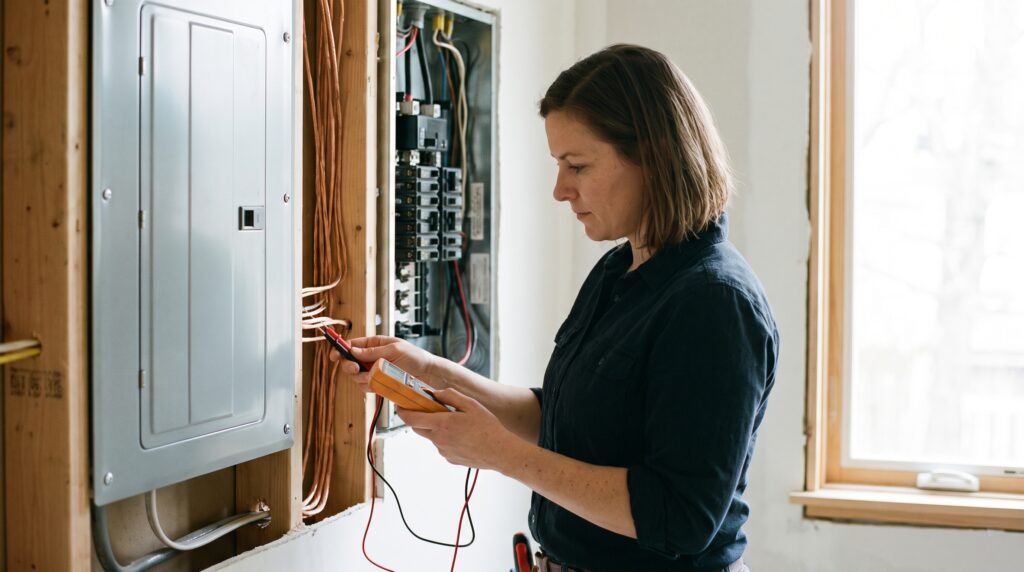
Upgrading your electrical panel increases the home’s total power capacity, but it cannot fix deteriorating insulation, loose neutral connections at the utility meter, or aluminum branch circuit oxidation behind your walls. As homeowners invest in home electrification, such as installing EV chargers and heat pumps, many mistakenly believe that a new breaker panel is a universal cure for all electrical issues.
When contractors sell panel replacements as a blanket solution for symptoms like intermittent light flickering, localized overheating, or ungrounded wiring, homeowners are often left with a costly bill and the exact same fire hazard they started with. Understanding the difference between total electrical capacity and branch circuit integrity is critical to diagnosing your home’s real electrical problems.
What is an Electrical Panel Upgrade?
An electrical panel upgrade involves replacing a home’s main service panel, typically to increase its total amperage capacity (e.g., moving from a 100-amp to a 200-amp service) and to install modern, reliable circuit breakers.
This upgrade expands the pool of available current for the entire house and replaces obsolete overcurrent protection, such as legacy Federal Pioneer Stab-Lok panels or outdated fuse boxes. However, this upgrade only addresses issues at the main distribution point. It does not replace the concealed branch wiring routed through your walls, nor does it resolve defects originating upstream on the electrical utility’s distribution grid.
5 Electrical Symptoms a Panel Upgrade Won’t Fix
If you are experiencing specific electrical malfunctions in your home, replacing the panel may not be the solution. Here is a diagnostic breakdown of common symptoms and why an upstream or downstream repair is actually required.
1. Severe Flickering and Asymmetrical Voltage Swings
Flickering accompanied by high voltage on some outlets and low voltage on others indicates an open or high-resistance neutral, a serious condition often requiring utility-side repairs rather than an internal panel replacement.
In a standard 120/240V residential service, the neutral conductor carries the imbalance of current back to the utility transformer. When this connection degrades or breaks (a floating neutral), voltage on one leg can drop significantly while surging on the opposite leg. This imbalance can damage sensitive electronics and introduces severe shock hazards.
Because the loose connection is typically located at the weatherhead, meter base lug, or utility pole, a new panel will not fix the issue. These supply-side faults require utility coordination (such as Alectra Utilities or Hydro One in Ontario) or meter base lug re-termination.
2. Warm Switch Plates and Arcing on 1970s Circuits
Warm outlets, scorch marks, and intermittent power in homes built between 1965 and 1976 are usually caused by solid aluminum branch wiring oxidizing at device connections, an issue that upgrading the main panel leaves entirely untouched.
According to research published by the U.S. Consumer Product Safety Commission (CPSC Publication 516), homes wired with pre-1972 aluminum branch circuits are 55 times more likely to have one or more wire connections reach “Fire Hazard Conditions” (temperatures exceeding 149°C / 300°F) compared to copper-wired homes. Aluminum expands and contracts faster than copper, oxidizes into an insulator, and suffers from mechanical creep.
Swapping the panel only updates the breaker termination. Effective remediation requires specialized pigtailing with approved connectors (such as AlumiConn lugs or COPALUM crimps) at device terminations, or a complete copper branch rewiring.
3. Brittle Insulation and Ungrounded Outlets
Active knob-and-tube (K&T) wiring with deteriorating cloth insulation and ungrounded circuits cannot be corrected by simply attaching it to a modern breaker panel.
Standard in homes built before 1950, K&T wiring lacks an equipment grounding conductor. Over decades, the rubber and cloth insulation becomes dry, brittle, and flakes away. While the Ontario Electrical Safety Code (OESC) sometimes allows connection to a new panel under strict conditions, this does not add grounding to two-prong outlets or eliminate the risk of exposed wires hidden in floor joists.
Furthermore, many insurance providers in Ontario require replacement of active knob-and-tube wiring with modern copper cabling (such as NMD90) before issuing or renewing coverage, rather than accepting a panel replacement alone.
4. Localized Breaker Tripping
If a breaker trips only when two appliances run simultaneously on the same room circuit, the issue is branch circuit overloading, not panel capacity. A 200-amp panel upgrade will not stop a 15-amp kitchen circuit from tripping.
A breaker trips when the amperage drawn by devices connected to a specific branch circuit exceeds its safety rating (for example, pulling 2,200 watts across a 15A branch line rated for 1,800 watts). Upgrading the total home service gives the house a larger pool of current, but it does not increase the localized capacity of that specific 14 AWG wire in the wall. The correct solution is running a new, dedicated 15A or 20A branch circuit home run from the panel to the appliance location.
5. Neighborhood-Wide Transient Dips
Transient power dips and flickering that affect the entire neighborhood are caused by environmental factors, degraded utility transformers, or sagging distribution infrastructure on the local utility grid. Because the problem exists upstream of the residential meter base, panel replacement cannot resolve this grid-level voltage instability.
When Do You Actually Need a Panel Upgrade?
While a panel upgrade won’t fix downstream wiring hazards or upstream utility faults, it is the exact correct solution for the following scenarios:
-
Electrification and High-Demand Additions: Adding a Level 2 EV charger (40A to 50A) or a modern heat pump system can push a home’s connected load past a standard 100A main service rating. In these cases, an upgrade to 200A service is often required based on load calculations.
-
Obsolete or Defective Hardware: Physical burn marks on bus bars, or the presence of obsolete, failure-prone panels (like Federal Pioneer) require a complete modern breaker panel replacement (e.g., Schneider, Eaton, Siemens) to ensure breakers trip reliably during a short circuit.
Regulatory Requirements in Ontario
In Ontario, all electrical work must be completed by a Licensed Electrical Contractor (LEC) registered with the Electrical Safety Authority (ESA), holding an active ECRA/ESA licence. Panel upgrades and major branch rewiring require an ESA notification of work (permit). Upon completion, the contractor provides an official ESA Certificate of Inspection to validate code compliance and satisfy insurance mandates.
Expert Diagnostics in the Greater Toronto Area
Properly diagnosing an electrical fault requires distinguishing between system-wide capacity constraints and localized wiring hazards. Before committing to a costly panel swap, ensure your contractor performs a comprehensive assessment.
Need a residential electrician in Newmarket?
When looking for a residential electrician in Newmarket, homeowners need an ECRA/ESA-licensed professional who can diagnose underlying branch wiring issues rather than just offering blanket panel replacements. Legacy homes in historic Downtown Newmarket or Gorham-College Manor frequently feature 1960s-1970s aluminum wiring or mid-century panels. Silco Energy Electrical Services (Silco Building Group) provides fully licensed residential electrical services with transparent upfront diagnostic testing to protect homeowners from unnecessary costs.
Looking for an electrical repair service in Newmarket?
A comprehensive electrical repair service uses diagnostic tools such as thermal imaging and load calculations to pinpoint urgent issues like floating neutrals or arcing receptacles. Timely repairs for power surges, sparking outlets, and intermittent circuit tripping require precision and expertise. Silco Energy Electrical Services provides specialized fault finding and diagnostics to ensure underlying electrical issues are properly resolved.
Hiring an electrical panel upgrade contractor in Newmarket?
A qualified electrical panel upgrade contractor in Newmarket handles end-to-end load calculations, ESA permitting, and utility coordination to ensure your home’s total service capacity is safely expanded. A proper 100A to 200A upgrade requires Alectra Utilities disconnection coordination and ESA inspection sign-off. As an ECRA/ESA-licensed contractor, Silco Building Group manages these complex upgrade projects with clear pricing, ensuring clients receive honest advice that distinguishes between real panel capacity needs and separate branch wiring hazards.